Create timeless memories with the perfect camera
Buy used:
$1.87
$3.98 delivery Wednesday, December 17. Details
Arrives before Christmas
Condition: Used: Good
Comment: Item in good condition. Textbooks may not include supplemental items i.e. CDs, access codes etc...
Access codes and supplements are not guaranteed with used items.
Only 1 left in stock - order soon.
Added to

Sorry, there was a problem.

There was an error retrieving your Wish Lists. Please try again.

Sorry, there was a problem.

List unavailable.
Kindle app logo image

Download the free Kindle app and start reading Kindle books instantly on your smartphone, tablet, or computer - no Kindle device required.

Read instantly on your browser with Kindle for Web.

Using your mobile phone camera - scan the code below and download the Kindle app.

QR code to download the Kindle App

Follow the author

Get new release updates & improved recommendations
Something went wrong. Please try your request again later.

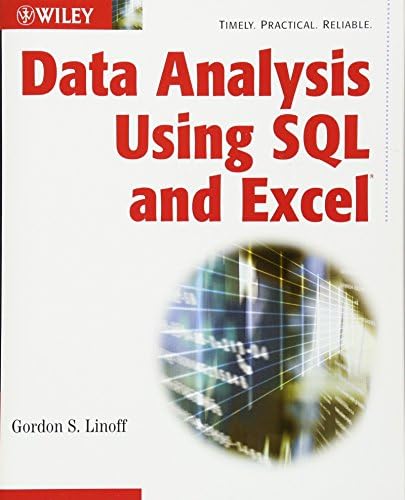
Data Analysis Using SQL and Excel 1st Edition

4.2 out of 5 stars (60)

Useful business analysis requires you to effectively transform data into actionable information. This book helps you use SQL and Excel to extract business information from relational databases and use that data to define business dimensions, store transactions about customers, produce results, and more. Each chapter explains when and why to perform a particular type of business analysis in order to obtain useful results, how to design and perform the analysis using SQL and Excel, and what the results should look like.

Editorial Reviews

From the Back Cover

Leverage the power of SQL and Excel to perform business analysis

Three key efforts are essential to effectively transform data into actionable information: retrieving data with SQL, presenting data with Excel, and understanding statistics as the foundation of data analysis. Data mining expert Gordon Linoff focuses on these topics and shows you how SQL and Excel can be used to extract business information from relational databases. He begins by taking a look at how data is central to the task of understanding customers, products, and markets, and he then goes on to show you how to use that data to define business dimensions, store transactions about customers, and summarize important data to produce results. Along the way, he shares stories based on his personal experience in the field, intended to enrich your understanding of why some things work—and others don't.

Each chapter explains when and why to perform a particular type of business analysis in order to obtain useful results, how to design and perform the analysis using SQL and Excel, and what you can expect the results to look like. Throughout the book, critical features of Excel are highlighted, interesting uses of Excel graphics are explained, and dataflows and graphical representations of data processing are used to illustrate how SQL works.

Data Analysis Using SQL and Excel shares hints, warnings, and technical asides about Excel, SQL, and data analysis/mining. The book also discusses:

  • How entity-relationship diagrams describe the structure of data
  • Ways to use SQL to generate SQL queries

  • Descriptive statistics, such as averages, p-values, and the chi-square test

  • How to incorporate geographic information into data analysis

  • Basic ideas of hazard probabilities and survival

  • How data structures summarize what a customer looks like at a specific point in time

  • Several variants of linear regression

The companion Web site provides the data sets, Excel spreadsheets, and examples featured in the book.

About the Author

GORDON S. LINOFF is a cofounder of Data Miners, Inc., a consultancy specializing in data mining. He is the coauthor of the bestselling Data Mining Techniques, Second Edition, and Mastering Data Mining (both from Wiley). He has more than a decade of experience applying data mining techniques to business problems in marketing and customer relationship management.

Product details

  • Publisher ‏ : ‎ Wiley
  • Publication date ‏ : ‎ October 1, 2007
  • Edition ‏ : ‎ 1st
  • Language ‏ : ‎ English
  • Print length ‏ : ‎ 645 pages
  • ISBN-10 ‏ : ‎ 0470099518
  • ISBN-13 ‏ : ‎ 978-0470099513
  • Item Weight ‏ : ‎ 2.2 pounds
  • Dimensions ‏ : ‎ 7.4 x 1.5 x 9.25 inches
  • Best Sellers Rank: #2,173,152 in Books (See Top 100 in Books)
  • Customer Reviews:
    4.2 out of 5 stars (60)

About the author

Follow authors to get new release updates, plus improved recommendations.
Gordon Linoff
Brief content visible, double tap to read full content.
Full content visible, double tap to read brief content.

Discover more of the author’s books, see similar authors, read book recommendations and more.

Customer reviews

4.2 out of 5 stars
60 global ratings

Customers say

Customers find the book excellent as a reference on data mining techniques, with one noting it contains 600+ pages of hard-earned knowledge. Moreover, the book is particularly effective for learning SQL queries and uses real-world business examples. Additionally, customers appreciate its readability.

16 customers mention "Information quality"15 positive1 negative

Customers find the book excellent as a reference on data mining techniques, being very informative and tremendously thorough, with one customer noting its generous 600+ pages of hard-earned knowledge.

"this book is just great, easy to read and very informative. I recomend it to anyone interested in this subject." Read more

"...piece of sql code and continues building it step by step, with clear explanations, so the reader doesn't get lost along the way...." Read more

"Excellent resource" Read more

"Very detailed discription and SQL code for people who are interested in learning and actually performing the data analysis...." Read more

10 customers mention "Knowledge level"10 positive0 negative

Customers find the book excellent for learning SQL queries and appreciate its use of real-world business examples.

"Excellent for learning SQL queries and pulling insights out of data...." Read more

"...Practical and to the point. Excellent examples. Good tie-in to data mining and Gordon Linoff's data mining techniques book." Read more

"...generating association rules for market basket analysis, building regression models, and implementing naïve Bayes classifiers and scorecards...." Read more

"...What really surprised me is that he does some of the Modeling in SQL. Association Rules was one of the examples...." Read more

4 customers mention "Data mining"4 positive0 negative

Customers appreciate the book's approach to data mining, with one customer highlighting its use of real data and another noting its focus on using SQL to extract information.

"...SQL code for people who are interested in learning and actually performing the data analysis. Practical and to the point. Excellent examples...." Read more

"...is an excellent reference on data mining techniques and how to use SQL to pull the data for Excel analysis...." Read more

"...This one is written for data analysts, data miners, and anyone who wants to extract maximum information value from large corporate databases...." Read more

"Data Analysis Using SQL and Excel..." Read more

4 customers mention "Readability"3 positive1 negative

Customers find the book easy to read.

"...His statistics review in this section and elsewhere in the book is quite readable, although very basic...." Read more

"this book is just great, easy to read and very informative. I recomend it to anyone interested in this subject." Read more

"So dry and dense I refused to read it. Not a good way to learn SQL" Read more

"...describes basic data analysis and statistical concepts in an easy to understand but thorough way. 2...." Read more

Top reviews from the United States

  • Reviewed in the United States on October 19, 2007
    Format: PaperbackVerified Purchase
    Gordon Linoff and I have written three an a half books together. (Four, if we get to count the second edition of Data Mining Techniques as a whole new book; it didn't feel like any less work.) Neither of us has written a book without the other before, so I must admit to a tiny twinge of regret upon first seeing the cover of this one without my name on it next to Gordon's. The feeling passed very quickly as recollections of the authorial life came flooding back--vacations spent at the keyboard instead of in or on the lake, opportunities missed, relationships strained. More importantly, this is a book that only Gordon Linoff could have written. His unique combination of talents and experiences informs every chapter.

    I first met Gordon at Thinking Machines Corporation, a now long-defunct manufacturer of parallel supercomputers where we both worked in the late eighties and early nineties. Among other roles, Gordon managed the implementation of a parallel relational database designed to support complex analytical queries on very large databases. The design point for this database was radically different from other relational database systems available at the time in that no trade-offs were made to support transaction processing. The requirements for a system designed to quickly retrieve or update a single record are quite different from the requirements for a system to scan and join huge tables. Jettisoning the requirement to support transaction processing made for a cleaner, more efficient database for analytical processing. This part of Gordon's background means he understands SQL for data analysis literally from the inside out.

    Just as a database designed to answer big important questions has a different structure from one designed to process many individual transactions, a book about using databases to answer big important questions requires a different approach to SQL. Many books on SQL are written for database administrators. Others are written for users wishing to prepare simple reports. Still others attempt to introduce some particular dialect of SQL in every detail. This one is written for data analysts, data miners, and anyone who wants to extract maximum information value from large corporate databases. Jettisoning the requirement to address all the disparate types of database user makes this a better, more focused book for the intended audience. In short, this is a book about how to use databases the way we ourselves use them.

    Even more important than Gordon's database technology background, is his many years as a data mining consultant. This has given him a deep understanding of the kinds of questions businesses need to ask and of the data they are likely to have available to answer them. Years spent exploring corporate databases has given Gordon an intuitive feel for how to approach the kinds of problems that crop up time and again across many different business domains:

    * How to take advantage of geographic data. A zip code field looks much richer when you realize that from zip code you can get to latitude and longitude and from latitude and longitude you can get to distance. It looks richer still when your realize that you can use it to join in census bureau data to get at important attributes such as population density, median income, percentage of people on public assistance, and the like.

    * How to take advantage of dates. Order dates, ship dates, enrollment dates, birth dates. Corporate data is full of dates. These fields look richer when you understand how to turn dates into tenures, analyze purchases by day of week, and track trends in fulfillment time. They look richer still when you know how to use this data to analyze time-to-event problems such as time to next purchase or expected remaining life time of a customer relationship.

    * How to build data mining models directly in SQL. This book shows you how to do things in SQL that you probably never imagined possible including generating association rules for market basket analysis, building regression models, and implementing naïve Bayes classifiers and scorecards.

    * How to prepare data for use with data mining tools. Although more than most people realize can be done using just SQL and Excel, eventually you will want to use more specialized data mining tools. These tools need data in a specific format known as a customer signature. This book shows you how to create these data mining extracts.

    The book is rich in examples and they all use real data. This point is worth saying more about. Unrealistic datasets lead to unrealistic results. This is frustrating to the student. In real life, the more you know about the business context, the better your data mining results will be. Subject matter expertise gives you a head start. You know what variables ought to be predictive and have good ideas about new ones to derive. Fake data does not reward these good ideas because patterns that should be in the data are missing and patterns that shouldn't be there have been introduced inadvertently. Real data is hard to come by, not least because real data may reveal more than its owners are willing to share about their business operations. As a result, many books and courses make do with artificially constructed datasets. Best of all, the datasets used in the book are all available for download at the companion web site [...]

    I reviewed the chapters of this book as they were written. This process was very beneficial to my own use of SQL and Excel. The exercise of thinking about the fairly complex queries used in the examples greatly increased my understanding of how SQL actually works. As a result, I have lost my fear of nested queries, multi-way joins, giant case statements, and other formerly daunting aspects of the language. In well over a decade of collaboration, I have always turned to Gordon for help using SQL to best advantage. Now, I can turn to this book. And you can too.
    50 people found this helpful
    Report
  • Reviewed in the United States on September 1, 2011
    Format: PaperbackVerified Purchase
    Gordon Linoff is a name I know from his co-authorship, with Michael Berry, of Data Mining Techniques: For Marketing, Sales, and Customer Relationship Management. I have read and rated highly the 2nd edition. The new edition of that excellent book came out this year.

    I am a long time Data Miner, but in almost all instances, my clients have access to specialized, dedicated, Data Mining tools, which have tons of powerful features. It's always been a bit of a mystery to me what Data Miners can do with Excel. I thought that it would have some SQL cases studies, and some Excel case studies. Upon reflection I feel a bit naive because, as his book makes clear, he is using the two tools in partnership. It is the SQL that is doing the heavy lifting. You can NOT do the kinds of analyses that he describes unless you are using SQL AND Excel. In fact, he is using Excel primarily for basic Data Visualization. What really surprised me is that he does some of the Modeling in SQL. Association Rules was one of the examples. I wouldn't have thought that was practical.

    What will you find in the book? In the first three chapters he introduces his main topics: SQL, Excel, and Statistics. His statistics review in this section and elsewhere in the book is quite readable, although very basic. In the next few (4-8), he uses some case studies to illustrate mostly data preparation tasks. Obviously it is majority SQL material, although he uses Excel charts and Excel functions in these chapters. If you are an Excel expert, but know nothing about SQL, don't expect that you will be able to coast on your Excel knowledge. You will be learning SQL. If you already know SQL, you will find it useful as well as these are not typical SQL tasks. He is performing analyses. The good news for all readers is that it is well written. In 9 and 10 he gets into modeling, but he does the modeling in SQL. In 11, he covers Regression, and here he uses mostly Excel. Finally in 12, he discusses how to prep the data to use it in a dedicated Data Mining tool, like the ones that I use, because "although powerful, the combination (of SQL and Excel) has its limits." So clearly SQL is the star, and Excel is the costar.

    I would recommend it for those that simply do not have access to a dedicated Data Mining tool, although beware that you will hit those "limits" eventually. I would also recommend it for Data Mining consultants that might encounter a client that does not have access to Data Mining software. It would be a good choice if your organization isn't ready for a large scale Data Mining project, but you want to stick your toe in the water. Finally, it might assist in putting together a demonstration for a tool-neutral audience. You can't go wrong with Linoff. He is an expert Data Miner, and he is good at writing about technical topics for a general audience.
    11 people found this helpful
    Report
  • Reviewed in the United States on July 27, 2011
    Format: PaperbackVerified Purchase
    This is an excellent reference on data mining techniques and how to use SQL to pull the data for Excel analysis. However, there are two things about this book that bother me. First, the vocabulary used by the author is quite extensive and usually elegant. However, it was sometimes annoying to have to stop and check the dictionary to find out what the author meant. Maybe this is more of a reflection on me than on the author but it seemed like there were many times where simpler language could have been used. Also, don't expect to learn how to run SQL queries from within Excel. That is outside the scope of this book so don't be misled by the book's title.
    11 people found this helpful
    Report

Top reviews from other countries

  • D
    5.0 out of 5 stars Analysis in practice
    Reviewed in the United Kingdom on June 4, 2021
    Format: PaperbackVerified Purchase
    Great book that ties in statistics, SQL and excel to solve specific business questions
  • Amazon Customer
    5.0 out of 5 stars Five Stars
    Reviewed in India on December 2, 2015
    A very good compilation of data analytics explaining the basics and then gradually moving to more technicalities.
  • malmo
    5.0 out of 5 stars Excellent book, easy to understand and practical
    Reviewed in the United Kingdom on August 30, 2012
    Format: PaperbackVerified Purchase
    This book is very informative, very useful. I am very happy that I bought it. As a data analyst, I find the explanations in this book really helpful. I'm sure I will go after all the titles by the author.
  • John.cooke
    4.0 out of 5 stars Four Stars
    Reviewed in the United Kingdom on January 5, 2015
    I want to cancel my order please and get the paper back version